Wednesday, 9 September 2015

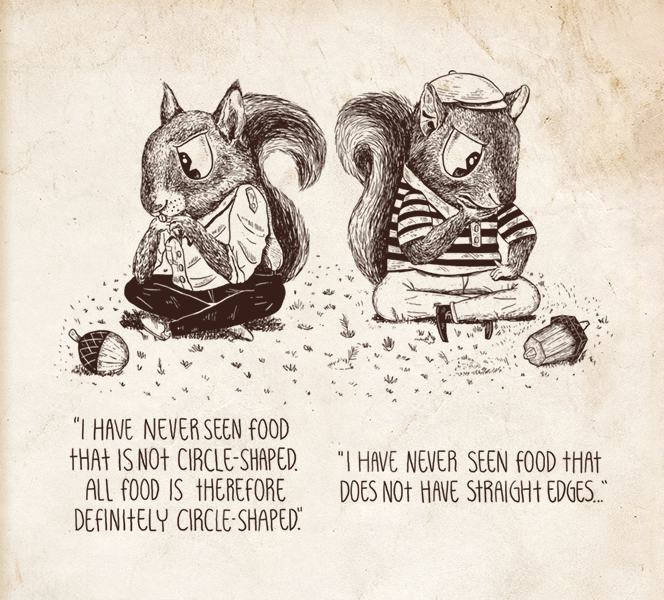
TOO MANY FALLACIOUS HASTY GENERALISATION AND INCREDULOUS APPEALS TO (QUESTIONABLE) POPULATION


you're welcome, I'm happy to offer another point of view.


Thanks for the kind gesture. I bet that is the best greeting a naturalist can give to each other. Kinda reminds me of the hunger games (1) where they say "...may the odds be with you..." to which I respond "how funny" because the odds don't even care neither do they know that they exist hahaha. But from a social POV, thanks for cheering me up :D


"And do you accept the notion/ proposition that "Choices are Free"?" - they cannot be free, but virtually any definition of free will has been debunked.


saying "they cannot be free" is a blanket assertion or argumentum ad lapidem. Please, show us your credible logical arguments. You made that claim, that burden of proof is on you.
saying "virtually any definition of free will has been debunked." does not provide any negation to the logically warranted arguments that freewill does exist. Consider your word "virtually" which according to the dictionary (2) means
"for the most part; almost wholly; just about:"
which by your own definition, and to avoid the fallacy of appealing to populations/ commonalities, there exists a definition of freewill that must be correct.
Now you appear to just Poison the Well rather than make the well better. In order to avoid making a fallacious toupee fallacy of appealing to personal incredulity, can you tell us what would make "Freewill" ACTUALLY "Freewill"?
How do you believe we ought to recognize Freewill if you and I saw one?
Then after you have provided this criteria, show us how every human freewill is NOT actually freewill but (pre)determined-will etc :)


"This "...we..." you keep using, who are the "we"? lol..." - the scientific community.


This is where I totally disagree with you. Your own bias is scientism (3). There are many things science has no authority over, in my opinion:
(1) Metaphysical or Existential Truths
(2) Moral or Ethical Truths
(3) Logical and Mathematical Truths
(4) Historical Truths
(5) Experiential Truths
(6) Aesthetics Truths
(7) Science itself

LONGER EXPLANATION

(1) Metaphysical or Existential Truths : Many Metaphysical truths cannot be proven using science. For instance (and these questions have existed for a LONG time now) Science cannot prove that you aren’t merely a brain in a jar being manipulated to think this is all actually happening. (Think of something like in “The Matrix”.) It also cannot prove that the world wasn’t created 5 minutes ago with the appearance of age (and with fake memories in your head, and half-digested food in your stomach, etc).  However it’s still rational to believe that our memories are true and that the world is real. How do you know you’re not dreaming right now? What if your mind is the only one that exists and your just imagining everyone else? None of these things can be proven but we’re not only reasonable for not believing them but believing one of them may land you in a mental ward lol.

(2) Moral or Ethical Truths : Science can’t prove any ethical truths. Science cannot prove that rape is evil. While it is possible to demonstrate, for example, that there are negative physical or psychological effects of rape, there is no scientific test that can prove it is evil. Science can describe how the natural world is, but moral truth carries an “oughtness” (how things should be) about it that goes beyond what merely is. There will never be an ONTOLOGICALLY SUFFICIENT AND OBJECTIVE/ ABSOLUTE scientific reason that survives logically warranted scrutiny for why what the Nazi’s did was wrong. Yet I think we’re all reasonable to believe they’re wrong.

(3) Logical and Mathematical Truths : Science cannot prove logic to be true because it assumes and requires logic in order for it to work. You can’t prove that logic or math work because the only way to do so would be to use logic or math. If all you follow is reason then how can you prove that reason works? This doesn’t mean we should never use logic or math it just means that it’s reasonable to believe in some things regardless if they can be proven.

(4) Historical Truths : Science cannot prove that Barack Obama won the 2008 United States presidential election. There is no scientific test we could perform to prove it. We could have an investigation if we wanted to confirm that he did actually win, but the method for proving historical truths is different from testing scientific truths since historical truths are by nature non-repeatable.

(5) Experiential Truths : Science cannot prove that your spouse loves you. When asked why so-and-so loves you, you may cite precedent (times when their behavior demonstrates their love for you) but this is a particular type of historical truth. There is no scientific test that can confirm a lifetime of experience of knowing a person.

(6) Aesthetics Truths : Science can’t prove truths about beauty. Science, try as it might, can’t explain why I like one poem over another. Still we’re all reasonable to believe that some things are beautiful and that some things aren’t - irrespective of qualia and the the golden ratio.

(7) Science itself : Consider the statement “Science is the only way to really know truth.” How could you prove that statement by science? It is actually self-refuting (circular reasoning) because there is no scientific test you could use to prove that it is true! Science (as hilarious as it is) can’t prove itself. Similar to number 3, for science to prove that it works it would have to use science. It’s impossible, yet we all are reasonable to believe in science.

Questions regarding scientism


(1) Could the scientific Community ever be wrong? e.g. there was a time the scientific community thought the sun revolved around the earth.
(2) What makes the scientific community correct in this case?
(3) What makes the scientific community an authority over this issue of "freewill"?
(4) Who makes up the scientific community?
(5) Does everyone in the scientific community unanimously agree within themselves concerning this issue or are you fallaciously appealing to certain (majority) population or are you fallaciously appealing to personal incredulity of the (certain population in this) scientific community?
(6) Which scientific community? Medical Doctors? Biologists? Neurologists? You mean neurologist like Wilder Penfield and Roger Sperry?
(7) Can you prove that everyone in the scientific community agrees with this or are you just philosophically assuming it?


"...irrelevant. The fact that 'others' believe the earth is 6000 years old doesn't support the fact you (and they) are wrong (just an example, don't mean to imply you hold this view)..."


But that still proves my point. "Who are this ..."we"... " ...that is the question I want to know and you make a non-sequitur point I agree with. You see, that same argument also falls on you. Watch me use your own arguments logically warranted back at you:
The fact that 'others' believe they dont have freewill doesnt support the fact that you (and they) are wrong...
So it seems to me that you agree with me that this "we" you keep talking of is totally misplaced as a hasty generalisation fallacy as "others" really do exist who dont agree with you :P


"...numerous metaphysical and philosophical presuppositions have been debunked in light of scientific investigations. This is another such instance..."


Again an appeal to population. This does not logically lead to the warranted justification that there are other philosophical arguments that science agrees with.


"...One could say you're appealing to dualism here" - no."


I'm glad you're not appealing to dualism. That is one factor cut out in trying to better understand you :)


"are you implying that we have wrongly locked criminals in prisons" - no.

"and condemned them wrongly because they are not the self-originators of the crimes they performed?" - yes.


So when a psychopathic serial killer and rapist rapes you, your family, kills your family, cuts your limbs in pieces but keeps you alive to traumatize your for 1 whole year. Can you honestly tell me that that guy is not at an moral fault because, as per your argument, he is not the origination and performer of his own action??? Im curious. _


"please demonstrate how Sam Harris semantically deals with the dichotomy between fatalism and determinism" - I invite you to watch his talk(s).


Yeah, please, refer me to his relevant talks :)


"So please, demonstrate a hypothesis to show how "the material world is all that there is". - I do not need to. Ask your doctor, when you are sick, to prove to you that your illness is material. Hint: non sequitur.


So, after my hypothesis that I gave to you - none of which you logically debunked, you refer me to go ask a doctor. hahahahaha ... you sound like the opposite version of a young earth creationist (YEC) who does not know how to argue his case but fallaciously commit an onus probandi lol.

me: demonstrate an hypothesis to show that "the earth is 6000 years old"
YEC: i do not need to. Ask my pastor to show you your sin is spiritual hahahaha

This is a category error and false dichotomy. I do not see the logical dichotomy between "immateriality" and "illness" in this context. The no-sequitur fallacy is in your court bro. This is the core for you bro... if you cannot explain that "materialism" is all that exists... it just seems to me that there is no good counter-argument or good-defeater to use the postulations of
(1) Quantum Physics - and its irregular nature to prove that another nature exists different from the nature of this material world. eg and electron could be in two places at the same time. (4)
(2) String Theory - and its 11 dimensions (5)
(3) Super String Theory - as if String Theory was not enough, now our mathematics is very much coherent with SUPER STRING THEORY (6).
(4) Wilder Penfield and Roger Sperry's experiments of dualism and idealism (7).
(5) The concept of infinity and its repeatable assumption in nature. eg fractals (8)

I'm sorry I am not convinced as you have not tackled the arguments that make me so convinced. This materialistic 3D dimension, in my opinion, is not all that exists - there is more as per the links i've provided you. And yes, I'm not the only one saying it, your very same scientific community is saying it.

God bless you :)

REFERENCES

Wednesday, 2 September 2015

THIS IS ALMOST NON-SEQUITUR

https://plus.google.com/106774038347107328330/posts/YbZaetpCuQx

INTRODUCTION

... whoop whoop! I'm glad that you are all warmed up and ready for this discussion lol. Im glad that you're as excited as I am. Wooooo! Let's do this lol.

OBJECTIVE - BUT WITH VIQ

VIQ = Very Important Question
I see that you are straying away from the discussion context that I am making. That is, the sequitur of subjects-matters like minds, immateriality etc. But you have branched off on another subject matter - RELIGION. I like the way you discuss because you do not like to bother yourself with the branches of a tree but you like to attack the root. hahahaha - you wise and sneaky fellow - i like that. I bet immediately you knew my bias you were like "Drop everything, let's deal with this religious nonsense if not we will not be able to make any progress." Well done lol... I like guys like you.
Now I have to apologise because I know it takes me quite a while to reply. I am a postgraduate on the verge of searching for a job and paying loans to the bank and the real reason I even engage in these discussions is because my friend +carmel Ka invites me to them lol. That is why I discipline myself with dedicated 1 hour minimum each day to associate in these delightful discussions.

The reason I apologised is because I want to reply to you but I too have made an assumption of your axiomatic bias - so far, that you are irreligious - since you are so good at hiding your background in the way you discuss lol. Sometimes, I almost confuse you for a religious person lol - (teasing you). I am apologising because I have to go on and reply to all that you have said even though I think it would be counter-productive to do so until you have answered this very important question:
Have you taken a degree in Christian Theology or are you well vastly conversant with Christian Theology???"


The reason I am asking this question is because I am going to go on along to have to teach or educate you on the how I believe God is very much coherent with sound philosophy.
sigh
So, to play it safe, I will answer "no" for you, for now, so that I can proceed with my reply. But a confirmation from you would be nice too.

PROCESSION

Now the same reason you reject Christianity is the same, but opposite reason I accept Christianity. Your argument, in the form of that demonstrated-discussion tries to prove that. However, I would say that that demonstrated-discussion does not settle well proving your point: That Christianity is a barrier to reasonable discussion. I think that this is a fallacious argument from analogy as it philosophically fails on the grounds of necessity. Why? Because I too could conjure up a demonstration-discussion analogy that could biased prove that you were wrong. It does not prove the point that Christianity is a barrier to reasonable discussion.
Secondly, this is also an Association-Causation Fallacy because the association of people with Christianity or Mental Sickness, does not necessarily Cause the Objective Truth of their argument. A mad-man could say "1+1=2" but that does not make it wrong or right by appealing to his mad incredulity lol. The reasonableness of discussion should be assessed more intellectually objective than this, in my opinion.

Thirdly, Christianity is a very big umbrella - although, we have 1 and the same core-values; and that is "Christ". That is to say, no "Christianity" without "Christ" lol. We are divided into sects; Catholics, Protestants, Pentecostals, Baptists etc. So it would a Fallacy of Composition to use one person's thinking faculty of Christianity to make a judgement about Christianity. This is why I still remain skeptical that Christianity can CAUSE unreasonable discussions.

YOUR DISCUSSION-CONTEXT DEMANDS

As earlier said in the Objective of this reply, I know the analogy is not your case... This is what you want me to address:
You want me to address my own take on this discussion
To which you can critique and logically discuss. OK... I accept :D

ATHEISM VS IDEALISM - a bit of contextual non-sequitur

When it comes to the debate over mind vs brain, we see that mind has different properties as opposed to the properties of the brain. If you want the vast amount of experiments that are out there to prove this point, just ask and I will show you. What I do not get is the mutual inclusivity of atheism and idealism in this same context. Rather than jump the gun, I would politely ask you:
How do you define Atheistic Idealism?
Does it mean that although the properties of mind and brain are different, they are both natural? Because, last time I checked, Atheism ONLY adheres to the natural realm ALONE. So a good logically warranted justification is needed on how an atheist can believe in idealism.

FINALLY - ANSWERING YOU LOL

(1) For necessarily inherent secondary aspect: mechanism:

I agree with this argument. Yes. It is definitely "most likely" as a vast amount of our existential experiences denote this and there are no strong counter-arguments for this in my opinion.

(2) For divided awareness:

Now I understand your context because at first I was gonna ask if you were hastily generalising the "we" in your premise 1; however, I love how you draw out the dichotomy between God and Man. God is Omniscient and HE is aware of everything that is a thing and not a logical contradiction. So yes, I agree with this and I agree that God does not imbibe the same nature of awareness as us and all of us are not enough - even collectively - to sum up the awareness of God lol.

(3) Argument for variation in qualia being the reason for causal activity and mechanism:

I totally agree. Premise 4's "most likely" is used intellectually honestly. Well done.

(4) Against intelligent non mechanical beginning:

Premise 1 does not apply to God - especially the Christian God. This is over-ruled but the Bootstrap Objection of Christian Theology (BOCT). In summary or layman's language, the BOCT says that for especially for abstract entities that the what cause of those abstract entities must necessarily and ultimately be that very same abstract entity. So, God did not just create good, truth, information etc God IS love, truth, information. Why? because HE is the FIRST EFFICIENT CAUSE of those things. So God cannot be "bad", "Lies", "Contradictory-information" because HE is not the FIRST EFFICIENT CAUSE OF THOSE THINGS. So in this argument, and seeing that God is not just a singularity, but God is The Singularity in and of HIMSELF, God does not just have a beginning - HE is "_The_ Beginning". This is also an argument to avoid the logical contradiction that an Infinite Regress of Beginnings exists.
Premise 4 disturbs me - and trust me, its not because I'm religious lol - think with me for a minute. I do not see the logical-coherent-connection between "Absolute Singleness or Simpleness" and "no-variation". I think you are asking for a one-ended stick here and this is logically unwarranted. So please, justify because I totally disagree. In my opinion, the kind of Absolute Singleness or Simpleness you are asking for here is special pleading.
This is also a simple-to-complex argument; which is special pleading. You need to warrant why ALL THINGS must always only move from simple-to-complex without fallaciously appealing to the consequence that "if it were so, then the explanation of the complexity would be even more complex than what is being explained". Who sets this rule up as a main logical objective? Even the primordial soup is not "simple". Even black holes and their singularities are not "simple". In fact, I think you will be violating a Philosophical Assumption of Science called "INFINITY" (1) - that the universe is infinite, both in the microcosmic and macroscopic directions. Even string theory does not argue for a single-ended string. It does not seem to me that it is a NECESSITY that things must start simple. In my opinion, one-ended sticks are a logical contradictions.
OR
A "Cause" eternally existing without an "Effect" eternally existing side-by, is a logical contradiction.
So I find it logically possible for events to EITHER move from simple to complex or from complex to simple as long as it is logically consistent. But making a law out of one direction must be logically warranted.
This is coherent with Christian Theology and Doctrine because God is incomprehensible; but do not fallaciously equivocate it with the fact that HE can be fully apprehensible.
If you need further Theological explanations for this, just ask and it will be given to you lol (Matthew 7:7) hahaha

(5) Argument for a-causal advent of variation of qualia:

Now this is where I play your game with you for now in the assumption that the above argument is right. Yes, I agree with this argument for that play-along-assumption.

But seeing that I am not satisfied with the previous argument, it special pleads how a-causality can create variation in the ABSOLUTE absence of variation. Where did that a-causality come from? I bring in the BOCT again to say that, therefore, whatever that "a-causality" is, it is therefore God.
In fact, God is a person. In Christianity, we say HE is (eternally) multi-personal. AND the only Candidate that fits that description of a-causality is "personality" - in my opinion.

(6) Argument against brute fact God agency creating mechanism:

I noticed that you are not arguing for the "God Theory" as postulated by Dr Bernard Haisch which is a model of Pandeism. Rather, you only poison the well of Theism's God Theory.  If that is the definition of "God Theory" you're using, then this is a very sound argument. I agree... but I do not think it applies to the Christian God. By virtue of this argument, you only appear to Poison The Well rather than make the well better. Yes you gave a meaningful argument but make it better - if there is no explanation in God Theory for the advent of mechanisms .... where do you consider the explanation to be? If there is no logically warranted answer, then it seems like your concept of who God is must therefore be DIFFERENT from the Christian God. You appear to be arguing for a Monadic Concept of God - the Islamic Kind of God. Well done in debunking that one. I would argue that you're right coz I almost see no flaw in your logic and every other "gods" of the other religions are question-begging and special pleading. But the God of Christianity, according to the BOCT, HE is both agency and mechanism. This is to say we believe in Tritheism of God's Hypostasis. God the father, God the Son and God the Holy Spirit. In the language of your very own context

- God the Agency - That which creates the cause
- God the Effect - The end of the stick of causality
- God the Mechanism - The producer that allows for transition between the Agent and Effect.

agency - Genesis 1:1 ... In the beginning, God created...
agency & mechanism - John 1:1-5 ... 1In the beginning was the Word, and the Word was with God, and the Word was God. 2He was with God in the beginning. 3*Through* him all things were made; without him nothing was made that has been made. 4In him was life, and that life was the light of all mankind. 5The light shines in the darkness, and the darkness has not overcome it.
Maybe it was the way that other Christian defined things for you. I'm sorry but many of us Christians just get things wrong.

THIS IS WHERE I EDUCATE YOU ON CHRISTIAN THEOLOGY

Lastly, I see you struggling with the Law of Identity. This is easy to prove by the fact that God is Infinitely Great. Even by virtue of the assumption of science in reference (1), infinite exists in order for our mathematics to be coherent. Now consider the following philosophical arguments for infinity:
- The Banach-Tarski Paradox
- Georg Cantor's Diagonal Argument for Infinite Uncountable Numbers
- Hilbert's Paradox of the Grand Hotel
- Hilbert's Paradox of the Grand Hotel from the perspective of Circle's Shape.
- Ian Stewart's Hyperwebster dictionary
- Ian Stewart's Hyperwebster dictionary from the perspective of a sphere
- Zeno's Paradox


We use the philosophy of infinity (2) in the Naturalistic Theism of Christian Theology and Doctrine. Just watch this video so that I do not have to explain each of those points (3).
1 + infinity = infinity
1 - infinity = infinity
1 x infinity = infinity
1 / infinity = infinity - ie according to philosophy lol
In fact, look at the video from time 8:13 to 9:24 - and notice how the circle never needed its missing piece to be complete when looking at it from the perspective of infinity.
But, to say, if mathematics behaves MOSTLY like this, then why is it impossible for God to ADD or SUBTRACT from HIS identity and HE still remains HIS very same identity? The subtracted piece from the circle can assume a new individual identity while God remains in HIS own unchanging identity. God is complete all by HIMSELF and in no need of you to add or subtract from HIM to complete HIM. God is not a Unitarian like a human being who when you subtract from his identity, he looses it lol. God is Infinite and multi-personal in the opinion of Christian Theology and Doctrine.

(7) Argument that mind is made of awareness and qualia:

I agree ... whoop whoop ... well done :) - you looked like you were on fire on that day writing this out lol - figuratively lol.

(8) ontological arguments.

Well, I debunked your controversy over the conservation of identity so, therefore, the very first premise of the ontological argument still stands in my opinion
It IS POSSIBLE that a maximally great being exists
In Christian Theology, when we say "Maximally Great Being (MGB)" we mean that God possesses "Greater Making Properties (GMP)". A Greater Making Property, as opposed to a "Lesser Making Property (LMP)" can be likened to the following
- GMP: an ever dripping tap becomes a mighty ocean and so much more at Maximum.
- LMP: an ever reducing ocean become impossible to exist at Maximum.

This first premise would be better if it said only 'it is possible that primary necessary being exists, ( leave out the 'a' so it reads '.....primary necessary being exists' to avoid automatically accepting brute fact supernatural associations the phrase 'a being' carries and recognize in the argument the word 'being' can be used differently).

I still find it special pleading and question begging as to where "a-causality" will come from to create variation, according to your arguments, when all that exists is ABSOLUTE singleness or simpleness. This, in my opinion, makes your "necessary primary being (NPB)" to be an impossible concept because it would be like asking for a one-ended stick. It is gibberish to me and logically inconceivable. God, according to Christian Theology and other versions of the ontological argument (e.g. St. Anselm's Ontological Argument (4)), is the Greatest Conceivable Being (GCB) and your NPB appears to be inconceivable and not powerful. It would not be "Self-Existent" but rather contingent on some sort of external a-causality. But if you meant to say "internal acausality" then that would be circular reasoning because you will be saying that "variation" existed before creation "variation". So my question still stands, "Where does this a-causality come from if all that previously exists is
 ABSOLUTE singleness or ABSOLUTE simplicity???

> 1.  If God exists then He is a maximally great being.
Well except he is not capable of creating mechanism, so not that great. He can't even exist since mechanism requires an explanation.
Since God is Self-Existent from all Eternity, where the Father Caused the Son and the Son Caused the Father. Think of it, you cannot be a Father unless a son is begotten by you. And a son cannot be a son unless he is begotten of you. Both of you elevate yourselves confluently to the title of Father and Son. Your argument here does not apply to the Christian God. When you're debating against a Muslim, for example, then you will be successful.

> 2.  A maximally great being would only entail maximally great qualities.
True but what is defined as great will depend on your perspective and your interpretation of life.
Although I adhere to idealism, I do not adhere to solipsism. Greatness, in my opinion, exists irrespective of my appeal to my incredulous perspective.

> 3.  A maximally great quality is a good quality to the maximum extent.
Okay. But good for what?
Please study some Perfect Being Theology in the Philosophy and Doctrine of the Christian Religion. (5)

John Mill argued that:
If in ascribing goodness to God I do not mean what I mean by goodness; if I do not mean the goodness of which I have some knowledge, but an incomprehensible attribute of an incomprehensible substance, which for aught I know may be a totally different quality from that which I love and venerate … what do I mean in calling it goodness? … To say that God's goodness may be different in kind from man's goodness, what is it but saying, with a slight change of phraseology, that God may possibly be not good? (6)
The question is not "Good for what"? A maximally great quality is a good quality because it is something that I love and venerate. Even satan loves and venerates "maximally great qualities" <>.

> 4.  Creating things is a good quality.
He can't create anything that isn't like himself. That would violate the law of conservation of identity. He can't produce this reality.
Debunked for Christianity by moi. But the argument is not "he can't do it" ... the argument is "it is a good quality for him to do it". But I guess you were just trying to make a point in your discussion category/ flow/ context.

> 5.  A maximally great being would entail by it's nature the good quality of being creative to the maximal extent.
Then God cannot be a maximally great being because there are limits to his creativity.
You make a category error here and moving the goalpost. Just because God is constrained/ limited by HIS MGB Nature to only do things that are Maximally Great - ie, only greater making things - does not rationally cohere with the fact that God is limited because HE cannot create a Lesser Making Property (LMP). As Christians, we already tell you "HE is a Maximally Great Being". But then you move the goalpost into the logical absurd and say, "But HE cannot create lesser making properties such as raping children or telling lies so HE is not so great for being limited to GMP alone." Then you have to prove that Infinity is limited because no matter how much you subtract from it, it is forever limited to being unlimited. This is logical jargon in my opinion.
Philosophically speaking, God doesn't exist because he would have been alone at the beginning with no possibility of creating mechanism. 
I agree... depends on your concept of God lol. Here's a video to help (I think) (7), (8). Even your NPB fails by this logically sound theoretical testing methodology.


If you start to talk of creation ex-nihilo I will point out that nothing cannot be so how can there be creation out of something that doesn't even exist. There was only God in the beginning so he only has himself to play with and create things out of.
Again, depends on your concept of God. But you see... you prove my point that even you yourself argue for the IMPOSSIBLITY of an ABSOLUTE-simple-to-complex transition and hence, your replacement argument of a Necessary Primary Being (NPB) ... does not stand your own critique.


CONCLUSION

You are logically sound all the way through but I do not think you have a very good concept of the Christian God. And your replacement fails your own criteria under special pleading grounds.
God bless you :D

REFERENCES

(6) Mill, John Stuart, 1865. “Mr. Mansel on the Limits of Religious Thought,” in Pike 1964: 37–45.

Wednesday, 26 August 2015

FREEWILL EXISTS, AT LEAST, COMPATIBLY


Alex Spevak z08840 & K railroads
*FREEWILL EXISTS, AT LEAST, COMPATIBLY*
*SALUTATIONS*
I have to admit guys, I have really enjoyed reading through your discussion. It took me a warping 3 days to go through it. You guys are well vast and respectable in your fields/ research and the common mutual respect here is astounding. I credit you guys for such a fun and polite discussion.
*PERSONAL BACKGROUND*
Now off the bat, I must lay to you my a priori bias so that you know where my background and where I am coming from. *I AM A CHRISTIAN* and a compatibilist. Personally, I believe that *"Choices are free"* but *"Consequences are determined"* For example, you can freely-choose to put your hands in fire, but you cannot choose the determinism that your hand will be burnt and you'd feel pain.... but that piece of relevant information does not necessarily equate to stereotyping me to whatever true or false conceptions you have about other Christians. I would appreciate it if you treated me objectively as a unique individual.
*AIM*
I want to make some comments regarding your discussion. I respect the fact that you guys have concluded your discussion and closed that era of conversation (I expect this may be red-herrings or non-sequiturs so I'll appreciate your mercy in not remembering some of your previous verbiages) but I think a new voice laying new concepts down would be creative, fun and would lead to even more enjoyable discussions for future readers/ participants. I do not necessarily agree with z08840 definition of freewill. I personally believe in my own opinion that K railroads is right regarding freewill. This is because there is *no scientific definition* of freewill. This is because scientific definitions are supported by scientific data - to which, if taking Michio Kaku correctly, the matrerialistic/ physical/ physics realm is determined - devoid of freewill. (This only applies if the physical realm is all that TRULY exists - but not so according to String Theory). Freewill is a philosophical term. But even in philosophical terminologies, Freewill has many "non-contradicting" definitions. I will argue for *THREE* philosophical definitions then give some Scientific support.*PHILOSOPHICAL DEFINITIONS*
1.) The Origination Argument
2.) The Logical Fatalism Argument
3.) The Causal Fatalism Argument
*1. The Originator Argument* (2)
1. An agent acts with free will only if she is the originator (or ultimate source) of her actions.
2. If determinism is true, then everything any agent does is ultimately caused by events and circumstances outside her control.
3. If everything an agent does is ultimately caused by events and circumstances beyond her control, then the agent is not the originator (or ultimate source) of her actions.
4. Therefore, if determinism is true, then no agent is the originator (or ultimate source) of her actions.
5. Therefore, if determinism is true, no agent has free will.
This defines freewill from a Thomas Aquinas vantage point that a person is their own *FINAL CAUSE* (freewill or Ultimate Source of Action) independent of *MATERIAL CAUSES* (determinism) (1). Thomas Aquinas argued against a reductio ad absurdum that *nothing can be an efficient cause of itself unless it was a FIRST CAUSE*. An example of final cause is a buttress from the Problem faced by many philosophers regarding intentionality (such as Haldan'e Argument) (3) and the Intentionality Argument (4) as a case for Dualism - _which by the way, has a lot of Scientific Supports (5)._  (I'm sure yo knew this already). But that's just one definition.
The next two syllogisms define freewill as the capability to do *ALTERNATIVELY* in freely choosing different world lines as analogously described by the 6th dimension of String Theory (3) & (6).
*2. The Logical Fatalism Argument*
Let S = the proposition that there will be a sea battle tomorrow.
(1L) Yesterday it was true that S. [assumption]
(2L) If some proposition was true in the past, it is now-necessary that it was true then. [Form of the Necessity of the Past]
(3L) That yesterday it was true that S is now-necessary. [1, 2]
(4L) Necessarily, if yesterday it was true that S, then now it is true that S. [omnitemporality of truth]
(5L) If p is now-necessary, and necessarily (if p then q), then q is now-necessary. [Transfer of Necessity Principle]
(6L) Therefore, that it is true that S is now-necessary. [3L, 4L, 5L]
(7L) If its being true that S is now-necessary, no alternative to the truth of S is now-possible. [definition of “necessary”]
(8L) So no alternative to the truth of S is now-possible [6L, 7L]
(9L) If no alternative to the truth of a proposition about the future is now-possible, then what the proposition is about will not be brought about by free human choice. [Version of Principle of Alternate Possibilities]
(10L) Hence, the sea battle tomorrow will not be brought about by free human choice. [8L, 9L]
*3. The Causal Fatalism Argument*
Let
H = a complete description of the world at some time in the distant past.
A = some future human act.
L = a statement of the causal laws
(1c) H and L
(2c) It is now necessary that H and L [the necessity of the past and the necessity of causal laws]
(3c) It is now necessary that [(H & L) → A] [thesis of causal determinism]
(4c) If it is now necessary that p and it is now necessary that (pq), it is now necessary that q. [transfer of necessity principle]
(5c) It is now necessary that A. [2,3,4]
(6c) If it is now necessary that A, then A will be not be done freely.
*MY "FREEWILL" DEFINITION"*
Hence, merging these two concepts together, I would like to define freewill in the way K railroads imposed about our existential experiences:
*_Freewill is ultimately endowed from an Efficient First Cause to agents with the power/ ability to collapse the wave function of superimposed alternative potential 6th (String Theory) dimensional worldline possible potentialities from a possible future to the present._*
*SCIENTIFIC SUPPORT*
*Quantum Biology*
InspiringPhilosophy created a video on Quantum Biology (7) (13) to analogously buttress that we superimpose 6th dimensional possible worldlines in our brains of "Stabbing Yourself" and "Not-Stabbing Yourself" at the same time in our brain. And the Quantum Observer Effect occurs in the brain (exclusive of a material conscious observer - which is a phenomenon) to 100% of the time you choosing to collapse the wave function of "Not-Stabbing Yourself". This bias choice is a good argument of freewill independent of materialistic causations.
*Eminent Experiments*
There have been experimental papers come up to show that the brain is determined 7 seconds before the decision is made (8). But this is not a good case for materialistic determinism. Wilder Penfield debunked it a long time ago and shows that it is POSSIBLE to escape causation/determination even in the process of causation/determination (9), (10), (11) in which the Patients could catch or stop their hands even while it was in the process of materialistic causation/ determination from electricity in the brain.Penfield has an affirmative case that consciousness and self-awareness are NOT materialistically caused/ determined. Wilder Penfield electrically stimulated the brains of epilepsy patients and found he could cause/determine them to move their arms and legs, turn their heads or eyes, talk, or swallow. Invariably the patient would respond by saying, "I didn't do that. You did". According to Penfield, "The patients think of themselves as having an existence separate from the material causation/ determination from the body."
No matter how much Penfield probed the cerebral cortex, he said, "There is no place... where electrical stimulation will cause a patient to believe or to decide" ... This makes it logical to post --- using the data-at-hand that self-awareness does not originate from a materialistically caused/ determined region.
Others have confirmed too like Roger Sperry (12) who's research made him confirm that materialism was false. He said:
_"By our current mind-brain theory, monism has to include subjective mental properties as causal realities. This is not the case with physicalism or materialism which are the understood antitheses of mentalism, and have traditionally excluded mental phenomena as causal constructs. In calling myself a ‘mentalist’, I hold subjective mental phenomena to be primary, causally potent realities as they are experienced subjectively, different from, more than, and not reducible to their physicochemical elements. At the same time, I define this position and the mind-brain theory on which it is based as monistic and see it as a major deterrent to dualism."_
Another Study showed a delay between the time an electric shock was applied to the skin, its reaching the cerebral cortex, and the self-conscious perception of it by the person. This suggests that "self" is more than just a machine that reacts to material causation/ determination stimuli as it receives them. The evidence is so abundant that even Laurence C. Wood said, "many Brian scientists have been compelled to postulate the existence of an immaterial mind, even though they may not embrace a belief in an after-life" .
This led Wilder Penfield to connote this quote:
_Although the content of consciousness depends in large measure on neuronal activity, awareness itself does not. To me, it seems more and more reasonable to suggest that the mind may be a distinct and different essence._
Lastly, even evolution which is random by nature, would not have given rise to life without anthropomorphising nature to resemble something that could "choose" called *Natural Selection* - as if evolution is not true until a bias towards a choice "say survival of the fittest" is chosen (that is, who chooses this bias from other alternative potentials?) - For example consider how the Cambrian Explosion debunks Darwins Evolution Theory by Natural Selection (14). I am not saying that "Nature" has freewill lol but I am saying that the Personal Agents in Nature (such as humans and animals) with their mental/ intentional states arguably display characteristics exclusive of physical nature's causation/ determination.
*IN CONCLUSION*
Personally, by definition of my own Freewill (and I'm not saying anything is wrong with z08840 definition) ... I believe freewill exists with credible logically warranted assumptions. That is, assuming:
(1) Philosophical Experiential Definitions are true
(2) Materialism is not all that exists
(3) Mental States are Different from Material States with regards to Quantum Physics/ Biology (_the observer effect_) - particularly, applying Leibniz law of indiscernibility of identicals.
(4) Materialism is not the sole efficient cause of Self-Awareness.
God bless you
*REFERENCES*
(1) https://en.wikipedia.org/wiki/Four_causes
(2) http://www.iep.utm.edu/freewill/
(3) http://guweb2.gonzaga.edu/faculty/calhoun/socratic/Steinmetz-Problem_of_Intentionality.pdf
(4) http://www.manyworldsoflogic.com/mindbody.html
(5) http://www.ncbi.nlm.nih.gov/pubmed/19351351
(6) https://www.youtube.com/watch?v=OdnhKE95AqM
(7) https://www.youtube.com/watch?v=6_xEraQWvgM
(8) http://exploringthemind.com/the-mind/brain-scans-can-reveal-your-decisions-7-seconds-before-you-decide
(9) https://books.google.co.uk/books?id=_SwX4yBwiCIC&pg=PT68&lpg=PT68&dq=wilder+penfield+i+didn%27t+do+you,+you+did&source=bl&ots=o21HjDVZ6m&sig=qyHd8jj2fX8rCOb3DOnTJ_MyWeQ&hl=en&sa=X&ved=0CCEQ6AEwAGoVChMI_IHh-8CyxwIVA7gUCh33Ow8D#v=onepage&q=wilder%20penfield%20i%20didn%27t%20do%20you%2C%20you%20did&f=false
(10) https://books.google.co.uk/books?id=92GqFgX3v9IC&pg=PA10&lpg=PA10&dq=wilder+penfield+i+didn%27t+do+you,+you+did&source=bl&ots=cHJXbaixoh&sig=qq366NXjmc49bl2wovceFkIoIHA&hl=en&sa=X&ved=0CDoQ6AEwBWoVChMI_IHh-8CyxwIVA7gUCh33Ow8D#v=onepage&q=wilder%20penfield%20i%20didn%27t%20do%20you%2C%20you%20did&f=false
(11) https://books.google.co.uk/books?id=Tnpdzx1lbFAC&pg=PA210&lpg=PA210&dq=wilder+penfield+i+didn%27t+do+you,+you+did&source=bl&ots=T7M7OyYgpe&sig=q5Xh3lJCc4asCM0YHIUsSEFrJ-0&hl=en&sa=X&ved=0CEgQ6AEwCGoVChMI_IHh-8CyxwIVA7gUCh33Ow8D#v=onepage&q=wilder%20penfield%20i%20didn%27t%20do%20you%2C%20you%20did&f=false
(12) http://people.uncw.edu/puente/sperry/sperrypapers/80s-90s/214-1980.pdf
(13) http://watarts.uwaterloo.ca/~sreinis/quantum.html
(14) http://izquotes.com/quote/222682

Thursday, 25 June 2015

Today without Liza–Day 1

All around in this this calm environment. I sit with my God… hoping, trusting, waiting on HIM. I am a Christian and want to stay that way for the many days and experiences I have had with my God. I love Liza… Liza, the girl I’ seeing right now. It brings me to tears. I remember asking her one day “Do you love me?” and she did not want to reply and say anything. She has doubts… oh my God she has doubts … you see, I live in England and she live’s in France. I am too confused to even write this blog down. How am I gonna collect myself? How am I gonna collect this blog together? Oh my… “look to Jesus… look to Jesus” … I tell myself. I am in love with Liza, but does she love me? I do not know and I do not want to demand it from her forcibly because I believe that true love is free and not forced.


Being in love is silly. My fingers can’t even write this blog properly. I’m just too overcome. Why? Why must I be overwhelmed by such feelings? –sigh. Well, enough. Mummy and Daddy are urging me. Friends are nudging me. I don’t want this. I’m tired. Next time they come to me and say,

“hey, what about your girlfriend….”

“…when are you gonna get married?…”

I would shut them up and say that I do not wanna talk about it. Let my soul sing… let my soul praise Jesus and rest upon his many goodness and favor. And let me forget about this. God works when we trust in HIM so I do not have to worry about it. Liza, my love… I do not know if you’re ever gonna have me or love me. I wanna loose you and move on with my life. But why this? How can I just go like that? How? It’s just not probable… Oh Jesus. I guess I have to trust in you Jesus… I wonder how henrietta is doing?


I totally dislike my father. Always butting into my life – what the heck! Such a control freak … but its sad because I am a control freak too. I don’t hate my daddy. I just hate the fact that I cannot hate him. He has caused me too much damage.


Till next time … this is me one day without Liza, the love of my life.


Ernie…

Tuesday, 2 June 2015

Finding and reading information


Task 1

Information about homeostasis

Homeostasis is the quality of a in which variables are delimited so that internal conditions remain stable and comparatively unceasing. Instances of homeostasis comprise the regulation of temperature and the equilibrium amid alkalinity and acidity (pH). It is a procedure that upholds the steadiness of the human body's interior environs in retort to vicissitudes in external conditions. The conception was designated by Claude Bernard (French physiologist) in 1865 and the name was devised by Walter Bradford Cannon in 1926. Granting the terminology was initially used to denote processes contained inside living organisms, it is recurrently pragmatic to automated control set-ups for instance thermostats. Homeostasis necessitates a sensor to identify variations in the condition to be delimited, an effector mechanism that can change that condition; and a negative feedback connection amid the two (Kent, 2000).

Control mechanisms

Altogether homeostatic control mechanisms possess at least three codependent mechanisms for the mutable being delimited: The receptor is the detecting constituent that keeps track and reacts to variations in the environment. When the receptor senses an incentive, it sends statistics to a "center of operations", the constituent that arranges the assortments at which a mutable is sustained. The center of operations decides an opposite response to the incentive. The center of operations then transmits information to an effector, which can be organs, muscles or other configurations that obtain information from the center of operations. Later accepting the signal, an alteration transpires to correct the nonconformity by depressing it with negative feedback (Kent, 2000).

Negative feedback

Negative feedback mechanisms involve of decreasing the output or action of some organs or set-up back to its typical assortment of operation. A decent illustration of this is managing blood pressure. Blood vessels can perceive opposition of blood stream touching the walls when blood pressure upsurges. The blood vessels perform as the receptors and they dispatch this communication to the brain. The brain then sends a communication to effectors such as the heart and blood vessels. The heart rate would decline as the blood vessels expand in diameter – this is also known as vasodilation. This alteration would trigger the blood pressure to plummet back to its typical assortment. The reverse would occur when blood pressure declines, and would produce vasoconstriction.

One more vital example is seen when the body is destitute of food. The body would then change the metabolic established place to an inferior value. This would permit the body to continue to work at a leisurelier degree, even if the body is starving. Consequently, people dispossess themselves of foodstuff while enquiring to decline in weight would discover it stress-free to cut-down weight originally and much difficult to not accumulate extra afterward. This is owing to the body's resolving the aforementioned to an inferior metabolic established place to permit the body to subsist with its truncated resource of energy. Isometrics can alternate this outcome by aggregating the metabolic ultimatum (Kent, 2000).


Analysis of the hormonal control of blood glucose levels in the body.

Glucose is the foremost foundation of energy-source for the cells in our bodies, however it's excessively immense to merely disperse in the cells by the aforementioned. As a substitute, it necessities to be conveyed into the cells. Insulin is a hormone created by the pancreas that expedites glucose transference into cells. By expediting glucose conveyance into cells commencing from the bloodstream, insulin depresses blood glucose intensities. It correspondingly deters glucose manufacture commencing from glycogen, fatty acids and amino acids, which is a carbohydrate comprised of numerous glucose subunit (Goodwin, 2010).

In detail, insulin essentially arouses glycogen establishment from glucose. All of these operations of insulin aid to lessen glucose intensities in the blood. But insulin isn't the solitary hormone that controls glucose intensities in the blood. Glucagon is a hormone manufactured by the pancreas that increases blood glucose intensities by causing the itemization of glycogen into glucose, causing glucose manufacture from fatty acids and amino acids, and causing the discharge of glucose commencing from the liver. Insulin and Glucagon possess hostile paraphernalia, with glucagon encouraging glucose manufacture and discharge into the bloodstream, and insulin encouraging the conveyance of glucose into cells from the bloodstream and constraining glucose manufacture (Goodwin, 2010).

Glucose intensities in the blood are generally quantified in expressions of milligrams per deciliter (mg/dl), with a typical assortment of 70 to 110 mg/dl. All in all, stipulating that glucose intensities drift out of this assortment, the quantities of glucagon and insulin manufactured by the pancreas will be attuned to fetch glucose intensities back into this assortment. It should be distinguished now that glucagon and insulin indications are not uncompromising retorts in typical persons. When the set-up is operating appropriately, there is continuously some glucagon and some insulin actually manufactured by the pancreas that is demanding to discover an equilibrium amid glucose acceptance into cells and glucose discharge into the blood (Goodwin, 2010).

image

Figure 1: Diagram displaying how insulin and glucose levels sharply increase correspondingly after a high carb repast (Wright, 2003 - 2015)

This diagram demonstrations the concentrations of glucagon, glucose and insulin in the blood, both after and before a repast that is great in carbohydrates. Carbohydrates exist fragmented down into monosaccharides, like glucose, afore they are rapt into the bloodstream by the small intestine. In this diagram, glucagon is the red line, glucose is the black line and insulin is the blue line (Wright, 2003 - 2015).

Afore the repast, glucagon intensities signified by the red line exist great, since no glucose is being rapt by the small intestine, so it must be dispatched by the liver, arousing glucose synthesis and dispatching from the liver are glucagon's foremost assignments. Nevertheless, immediately once a high-carbohydrate repast, glucose intensities in the blood sharply increase higher making insulin intensities sharply increase higher too. The insulin sharp increase is in reaction to the greater glucose intensities, but it occurs so rapidly that the two sharp increases ensue virtually concurrently. Actually insulin intensities escalate when glucose intensities escalated and plummet when glucose intensities plummet (Goodwin, 2010).


Task 2

Hint

This is a trivial or ancillary signal or recommendation. E.g. "he has set no hint of his opinions"

Suggestion

This is a hint or plan put presumptuous for contemplation. E.g. "here are some suggestions for confronting the delinquent"

Connotation

This is an inkling or sensation which a term beseeches for an individual furthermore to its verbatim or principal implication. E.g. "the term ‘discipline’ possesses ill-fated connotations of reprimand and subjugation"

Allusion

This is an expression intended to call something to attention devoid of stating it unambiguously; a subsidiary or ephemeral reference. E.g. "an allusion to Shakespeare"

Inference

This is a deduction gotten on the foundation of proof and rationalisation. E.g. "scientists are commended with drawing inferences from the facts"

Assumption

This is something that is putative as true or as assured to occur, deprived of evidence. E.g. "they created certain assumptions about the marketplace"

Irony

This is the expression of one's connotation by means of linguistic that usually indicates the contrary, stereotypically for hilarious or ardent effect. E.g. "‘Don't go overboard with the appreciativeness,’ he rejoined with heavy irony"

Sarcasm

This is the use of irony to scorn or express contempt. E.g. "she didn't like the annotation of sarcasm in his speech"

Metaphor Symbolic

A metaphor is an idiomatic expression that utilises the practice or talent of using a thing or an expression to symbolize an abstract idea. E.g. Time is money: This is emblematic since it cautions you that when you expend your time, you are giving up the prospect to be undertaking something different with that time (just as when you expend your money, you give up your fortuitous to do something else with the money). Additionally, like money, time is not unlimited.

Numeric Coding

This is the process of utilizing a code whose objective character set comprises merely numerals and/or strings of digits, e.g. a binary code.

References

Goodwin, M. L., 2010. Blood Glucose Regulation during Prolonged, Submaximal, Continuous Exercise: A Guide for Clinicians. Journal of Diabetes Science and Technology | From Basic Science to Clinical Practice, IV(3), p. 694–705.

Kent, M., 2000. Advanced Biology. New York: Oxford University Press.

Wright, S., 2003 - 2015. Homeostasis of Glucose Levels: Hormonal Control and Diabetes - Video & Lesson Transcript | Study.com. [Online]
Available at: http://study.com/academy/lesson/homeostasis-glucose-levels-and-osmolarity-hormonal-control.html
[Accessed 10 May 2015].